 Aren Mehrabyan Foundation
Participants of the second Artsakh war produced the first hydroponic device
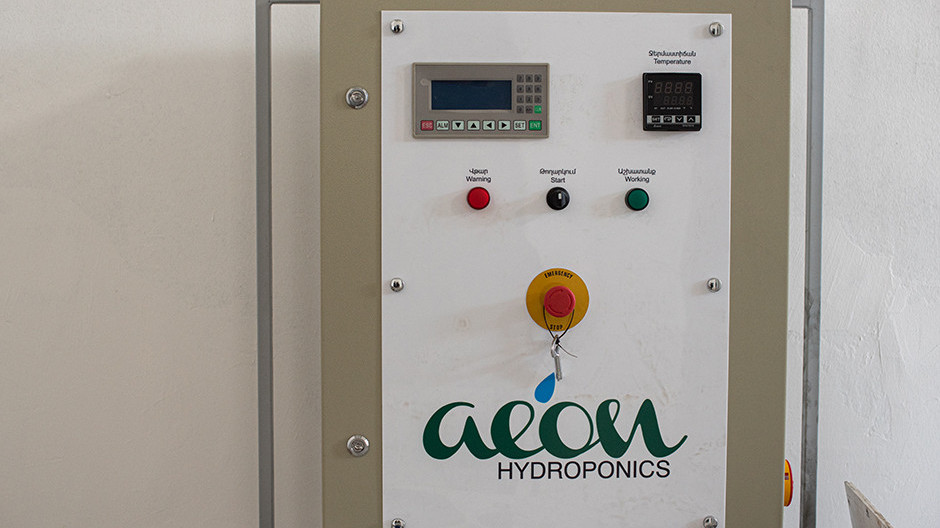
The first "AEON" hydroponic device is now ready, developed, and produced by participants of the Second Artsakh War. The “Engined AM” company, founded by the “Aren Mehrabyan” Charitable Foundation, manufactures these devices. Last autumn, the foundation initiated training courses for war-disabled individuals, war participants, and family members of martyred soldiers, focusing on high-quality engineering and technical skills.
“War participants need education and jobs. We strive to provide them with professions and financial security,” says Mher Mehrabyan, founder of the “Aren Mehrabyan” Charitable Foundation. Mher and Satik Nairyan founded the charity in memory of their son, Aren Mehrabyan, an artilleryman who died on October 28, 2020, during the war. In an interview with “Hetq,” Mher emphasized that strengthening Armenia is the only way to give meaning to his son’s death.
A year later, Mher realized Aren’s dream by establishing a research, development, and manufacturing center for aerospace engines and VTOLs in Armenia. Mher states that “AEON” hydroponics is one of the pilot programs of “Engined AM,” marking the start of a larger production effort. Efficient use of time and training a skilled workforce are crucial for addressing more complex issues.
According to Mher, the biggest challenge to large-scale production in Armenia is the lack of skilled specialists due to insufficient vocational education. The foundation already trains its second group of 3D modeling and web programming specialists, offering free four-month courses.
Satik Nairyan, deputy director of the foundation and co-founder of “Engined AM,” highlights that war participants are the driving force behind the program, comprising 90% of the labor force. Some graduates of the 3D modeling and web programming courses have already started working at “Engined AM,” balancing study and work.
The initial training group started with sixty participants but decreased over time due to various reasons, with 16 graduating from the 3D modeling course. Many participants face health issues and continue their rehabilitation treatment.
The second stage of web programming and 3D modeling courses began in February. The Mehrabyan family finances the entire teaching process, including salaries, rent, and other expenses. Mher emphasizes that continuous education is essential, expecting professional quality in work. Participants’ responsibilities and salaries are determined by their grades. They have opportunities for further education or can repeat the course if needed.
“Engined AM” began serial production of hydroponic devices in January. Satik explains that farmers without enough pasture are interested in these devices. After the war, 20,000 hectares of land remained in neutral territory, forcing peasants to reduce their livestock.
According to Satik, “Smart Livestock” farmers understand the necessity of hydroponic equipment. From one square meter, enough fodder is produced to feed two milkers. Producing 1 kg of hydroponic fodder requires only 1.5 liters of water, compared to 80-90 liters for growing 1 kg of green grass in the field. Hydroponic fodder can feed all types of livestock and poultry.
Large farms in Dilijan and Hrazdan already use hydroponic devices imported from Turkey or China. The “Engined AM” program, developed with the “Association of Feed Producers,” aims to create a more accessible and efficient device. The AEON hydroponic device is easier to transport and maintain, requiring no special conditions or additional costs.
Correspondence with the RoA Ministry of Economy indicates that the AEON program is a government priority, potentially eligible for a 10% bank or leasing subsidy. The company has received positive responses from banks and leasing companies, with some signing memorandums to finance the project.
Last year, the company won a 50 million AMD grant from the Ministry of High Technologies to create a free engineering, construction, and scientific research laboratory. Mher explains, “Here people can implement their ideas with scientific guidance, from calculations to realization.”
The next step is to establish an Armenian aerospace agency to unite top specialists. “We need an administration to solve professional problems and provide consultancy,” says Mher Mehrabyan.
Author: Sara Petrossyan

